
You Don't Have a Team Problem. You Have an Identity Problem.
By Julia & Nathan | Your Elevated Edge | Leadership & Team Development
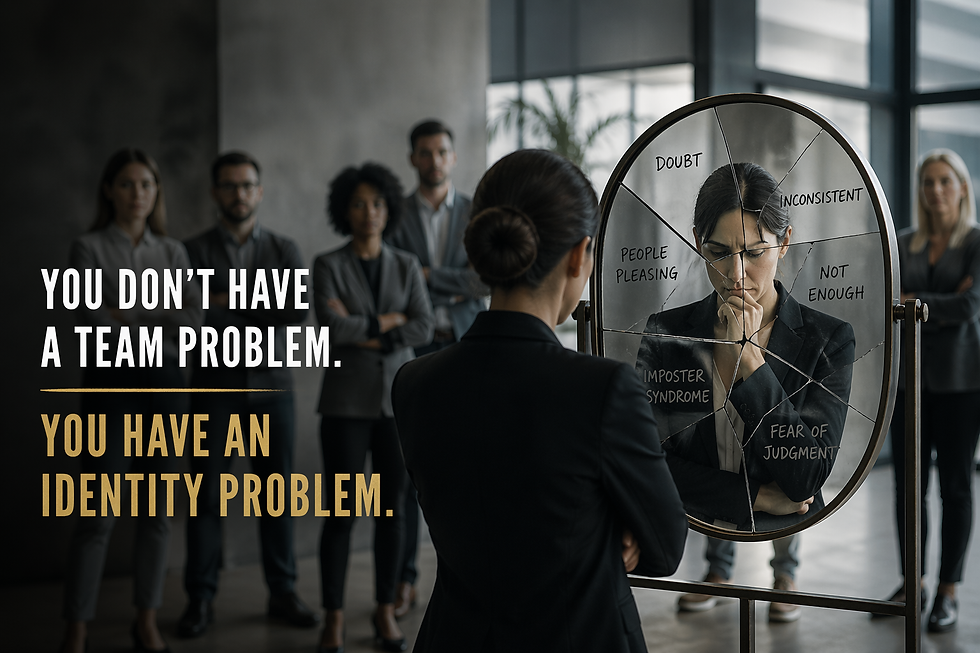
Let's be honest. You've tried the team-building retreat. You've done the communication workshop. You've hired good people, set clear goals, and still — something isn't clicking.
There's friction where there should be flow. Silence where there should be trust. Conflict that keeps circling back no matter how many times you think you've resolved it.
Here's what most leadership consultants won't tell you: the problem isn't your team. It's that your team members don't truly know themselves — and neither, probably, do you.
Not at the level that matters. Not at the core.
This is the work Julia and Nathan do at Your Elevated Edge. Not surface-level team training. Deep, identity-level transformation — starting with each individual — that changes how people show up for themselves, for each other, and for the mission they're there to fulfill.
The Myth of the Team Problem
When teams struggle, leaders instinctively look outward. They look at processes. At org charts. At who's not pulling their weight. At communication breakdowns between departments.
But teams are made of people. And people are made of beliefs, values, emotional patterns, and driving forces that are largely invisible — even to themselves.
When someone shuts down in a hard conversation, that's not a communication problem. That's an identity response — a deeply wired reaction rooted in how they see themselves and what they value most.
When a manager avoids giving feedback, that's not a leadership skills gap. That's a driving force at work — possibly a deep need for harmony, or a fear of being perceived as unjust.
You can train people on skills all day long. But until they understand the identity underneath the behavior, the behavior doesn't change. Not for real. Not for good.
What Identity-Level Work Actually Looks Like
At Your Elevated Edge, Julia and Nathan start every team engagement the same way: by going deep with each individual before addressing the group dynamic.
Julia works one-on-one with each person on the identity side — the inner work. She helps people identify and release the beliefs, emotional patterns, and deep-seated programming that are quietly driving their behavior.
Think of it this way: most people are running on outdated internal software. Old code written years ago — often in response to pain, failure, or fear — still shapes how they react in high-stakes moments, how they show up in conflict, and how much they believe they're capable of. Julia's work is the upgrade. New programming. New defaults. A new foundation to build from.
Alongside that inner work, Julia and Nathan use two powerful TTI assessments with every team member:
TTI Emotional Intelligence (EQ): This assessment measures how well someone recognizes, understands, and manages emotions — both their own and others'. It surfaces the emotional patterns that drive behavior under pressure, in conflict, and in high-stakes moments. EQ isn't about being emotional. It's about being intelligent with emotions — and it is one of the single greatest predictors of leadership effectiveness.
The 12 Driving Forces: This framework reveals the core motivators that shape why people do what they do. Not just what they're good at — but what drives them at a fundamental level. There are 12 distinct forces, from a drive for knowledge and utility to needs around harmony, power, altruism, and more. When someone's driving forces are misaligned with their role or team culture, no amount of skill training will fix the disconnect.
Together, these tools give each team member a mirror — often for the first time in their professional life. They stop wondering why they react a certain way. They stop blaming others for friction that was actually a values collision. They gain the self-knowledge to make intentional choices instead of unconscious reactions.
The Ripple Effect on Teams
Here's what happens when every person on a team does this work:
Conflict becomes productive. When people understand their own driving forces, they can recognize when a disagreement is really a values difference — not a personal attack. That reframe alone changes everything.
Trust deepens fast. There's something powerful that happens when a team sees each other's inner landscape. Judgment softens. Empathy grows. People stop assuming the worst about each other's motives.
Hard conversations become possible. When you understand your own emotional triggers and someone else's driving forces, you can approach difficult dialogue with precision and care instead of avoidance and anxiety.
Leaders lead from strength, not fear. Identity clarity is the foundation of confident leadership. When leaders know who they are and what drives them, they stop second-guessing every decision and start moving with purpose.
This Isn't Therapy. It's Strategy. We want to be clear: this work isn't about navel-gazing or turning the workplace into a therapy session. It's about competitive advantage. Organizations with high emotional intelligence consistently outperform their peers.
Where Do You Start?
The answer is simpler than most people expect: you start with yourself.
Before you can lead a team into deeper self-awareness, you have to be willing to go there first. What are your driving forces? How emotionally intelligent are you under pressure? What blind spots are shaping your leadership without your awareness?
That's the conversation Julia and Nathan love to start.
Julia works one-on-one with each individual to go deep, releasing the limiting beliefs and old programming that keep people stuck.
Nathan brings the strategic and team systems lens, weaving those individual breakthroughs into cohesive, high-performing team systems.
Together, they close the gap between who your team is today and who they're capable of becoming. Every great team transformation we've witnessed began with one person — usually the leader — deciding to stop pointing at the team and start looking in the mirror.
Are you ready to find your elevated edge?
Let's start with you. If you're ready to do the deep work — for yourself and your team — Your Elevated Edge is here. We'll guide you through TTI EQ and the 12 Driving Forces, and build a development plan that creates lasting change from the inside out.



Comments